

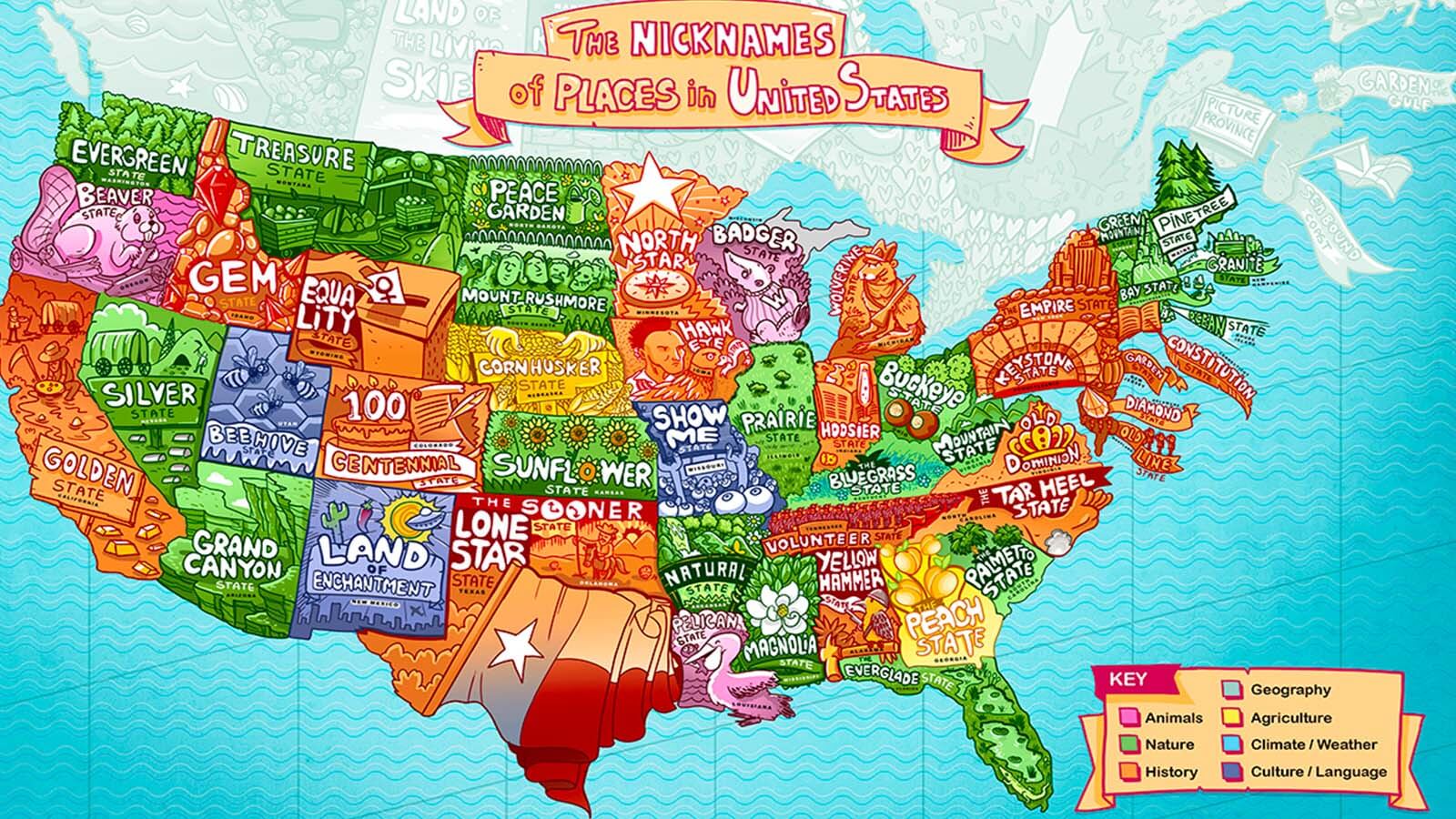
Pop quiz. What’s the Pelican State?
If you said Louisiana, you’re either from there or you’re guessing. Most Americans have no idea. But ask about the Big Easy? Everyone knows New Orleans.
State nicknames occupy a weird space in American culture. Some are more recognized than the actual state names. Others are completely forgotten. Many states have multiple nicknames competing for attention.
This wasn’t planned. It just happened.
Contents
The Original Nickname Kings
New York got lucky. “The Empire State” stuck early. Governor George Clinton used the term in the 1780s, predicting New York’s commercial dominance. He was right. The nickname spread through newspapers, business correspondence, official documents. By 1850, nobody questioned it.
California had similar luck. “The Golden State” emerged during the Gold Rush of 1849. Obvious symbolism. Memorable phrasing. It appeared on everything from railroad advertisements to hotel letterhead. The state made it official in 1968, but everyone already knew it.
Texas never needed to make anything official. “The Lone Star State” referenced the single star on the state flag. The flag came from the Republic of Texas days (1836-1846). Independent nation. One star. Perfect branding that outlasted the republic itself.
The Forgotten Alternatives
Here’s where it gets interesting. Most states have multiple nicknames. Official and unofficial. Historical and modern. Competing for recognition.
Indiana is “The Hoosier State.” Everyone knows that. But it’s also been called “The Crossroads of America.” Highway intersection symbolism. Interstate 70 and 65 cross at Indianapolis. Made sense for the automobile age. Appeared on license plates from 1937 to 1956.
Nobody calls it that anymore. Hoosier won. Why? Nobody knows for sure. The word itself has disputed origins. Some claim it comes from frontier slang for “Who’s there?” Others trace it to settlers from the Hoosier Gap in Cumberland, England. Regardless of etymology, it stuck. The alternative didn’t.
When Nicknames Backfire
Some state nicknames aged poorly. Missouri calls itself “The Show-Me State.” Sounds confident. Self-reliant. Actually started as an insult.
The phrase emerged around 1899. Congressman Willard Vandiver allegedly said, “I’m from Missouri, and you’ve got to show me.” Implying Missouri folks were skeptical. Stubborn. Needed proof before believing anything. The state embraced it anyway. Turned skepticism into brand identity.
Arkansas went through multiple identity crises. “The Natural State” appears on license plates now. Clean. Environmental. Tourist-friendly. But older residents remember when it was “The Land of Opportunity.” Before that, “The Wonder State.” The state kept rebranding, searching for the right message.
None matched the unofficial nickname everyone actually used: “The Razorback State.” After the wild hogs. After the University of Arkansas mascot. That’s what stuck in popular culture, whether the tourism board liked it or not.
The Multiplicity Problem
Florida embodies nickname chaos. Official nickname: “The Sunshine State.” Used on license plates since 1970. Makes sense for tourism marketing.
But Floridians also claim “The Orange State” (citrus industry), “The Everglades State” (geography), “The Peninsula State” (obvious), and “The Alligator State” (wildlife). Each represents different aspects of state identity. None achieved the dominance of Sunshine State, but they persist in regional usage.
This multiplicity reveals how state symbols actually function. They’re not monolithic. Different constituencies use different symbols and names for different purposes. Tourism wants one message. Agriculture wants another. History buffs prefer historical accuracy over marketing appeal.
Geographic Laziness
Some states barely tried. North Dakota: “The Peace Garden State.” After the International Peace Garden on the Canadian border. Accurate but uninspiring.
South Dakota went with “The Mount Rushmore State.” Fair enough. You’ve got four presidents carved into a mountain. Use what you’ve got.
Delaware chose “The First State” because it ratified the Constitution first. Factual. Boring. Nobody outside Delaware cares about ratification order.
These geographic or chronological choices lack the poetry of “Land of Enchantment” (New Mexico) or the swagger of “The Last Frontier” (Alaska). They’re bureaucratic decisions. Official nicknames that never captured public imagination.
When Marketing Wins
Virginia pulled off brilliant rebranding. The old nickname was “The Old Dominion”—referring to its status as England’s oldest colonial possession. Historical. Accurate. Completely meaningless to modern Americans.
Tourism marketers pushed “Virginia is for Lovers” starting in 1969. Not technically a state nickname. A tourism slogan. But it worked better than any official designation. People remember it. They repeat it. They visit because of it.
The lesson? Sometimes marketing beats history.
Why Nicknames Matter
State nicknames serve a purpose beyond tourism brochures. They’re shorthand for identity. They give states personality. They create instant recognition.
Say “The Sunshine State” and people picture beaches, palm trees, retirement communities. Say “The Last Frontier” and they imagine wilderness, adventure, isolation. These mental associations matter. They shape how states present themselves and how others perceive them.
The most successful nicknames balance accuracy with aspiration. They reflect something true about the state while projecting an idealized image. Golden State. Empire State. Lone Star State. Each captures both reality and mythology.
The Ones That Never Stuck
Every state has rejected nicknames. Names that appeared in old documents but never gained traction. Illinois was briefly “The Sucker State” (after a type of fish). Pennsylvania tried “The Keystone State” (geographic centrality). Both are technically official. Nobody uses them.
These failures show that official designation means nothing without popular adoption. Legislatures can declare nicknames. Citizens decide which ones to actually use.
The gap between official and popular reveals the democratic nature of language. Governments can’t force adoption. They can only suggest. People vote with usage.
Fifty states. Dozens of competing nicknames. Some triumphant. Some forgotten. All revealing how Americans create identity through language, one catchphrase at a time.


