

The AI research team Soul AI Lab at Soul App, a Chinese AI social platform, has open-sourced SoulX-FlashHead, a 1.3B-parameter real-time avatar generation model designed for high performance with a lightweight architecture. Running on a single RTX 4090 consumer GPU, the model can achieve 96 FPS generation speed while maintaining high visual quality. Compared with solutions that rely on large-scale computing clusters, SoulX-FlashHead offers a more accessible approach to real-time avatar generation.

The paper, code, model weights, and dataset for SoulX-FlashHead are now publicly available. Developers can access these resources through the research paper, the GitHub project repository, the Hugging Face model hub, and the VividHead dataset.
SoulX-FlashHead provides two versions designed for different use cases: Lite and Pro.
The Lite version prioritizes speed. On a single RTX 4090 GPU, it can reach 96 FPS inference speed while using about 6.4GB of VRAM, and it supports up to three concurrent streams. This performance significantly exceeds the 25 FPS threshold typically required for real-time video generation, allowing avatar systems to run on personal workstations.
The Pro version focuses on visual quality. On a single RTX 5090 GPU, it runs at approximately 16.8 FPS, while a dual-GPU setup enables real-time generation above 25 FPS. In benchmark evaluations, the Pro version achieves state-of-the-art results in FID (visual quality) and lip-sync accuracy, with some metrics surpassing models with larger parameter sizes.
To maintain stable performance in a lightweight model, Soul AI Lab introduced several architectural improvements. One key technique is Oracle-Guided Distillation, a bidirectional distillation framework. The method introduces a teacher model with a global perspective during training and uses ground-truth signals as anchors. As a result, facial features remain consistent even in extended sequences.
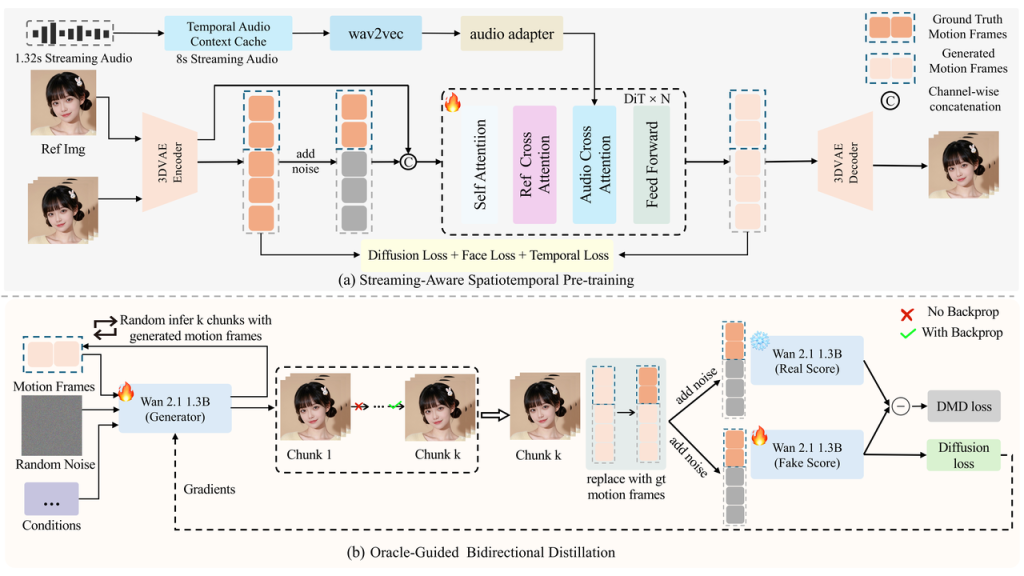
Another optimization is Temporal Audio Context Cache (TACC). In real-time generation pipelines, audio is typically processed in short segments, which can cause lip movement jitter or synchronization errors. SoulX-FlashHead addresses this issue by caching eight seconds of historical audio features, providing the model with richer temporal context and improving lip-sync stability.
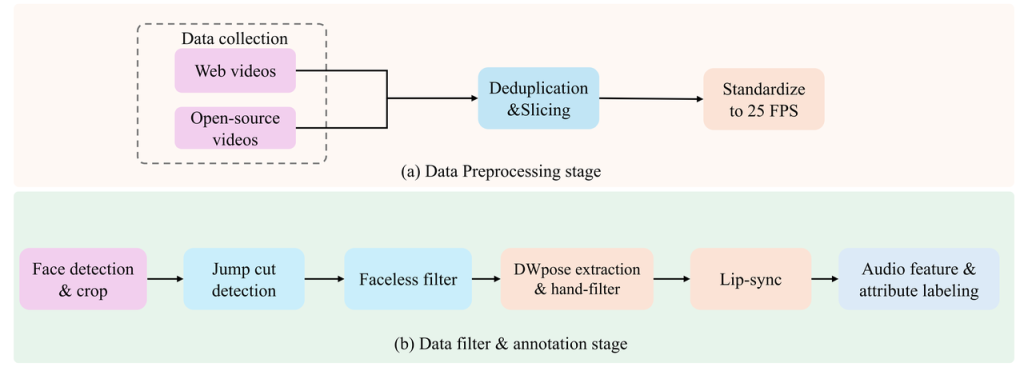
The training process is also supported by a high-quality dataset, VividHead. The 782 hours of audio-visual data was curated from more than 10,000 hours of raw video material. The data went through multiple processing stages, including video segmentation, DWpose keypoint extraction, and lip-sync score filtering, ensuring a clean and reliable training foundation.
SoulX-FlashHead demonstrates strong results on the HDTF and VFHQ datasets. On the HDTF high-definition benchmark, the Pro version achieved FID 8.31 and FVD 103.14, indicating strong visual fidelity. On the VFHQ dataset, which contains more complex real-world scenes, the model achieved a Sync-C score of 5.60, showing improved audio-visual synchronization.
The lightweight model also opens the door to broader real-world applications for real-time avatars. Developers can run a 24/7 avatar livestream on a standard gaming PC. The 1.3B parameter size also makes the model easier to integrate into games, enabling NPCs to respond in milliseconds without competing for core rendering resources. In addition, the model can support AI tutoring across 15 languages, where real-time audio drives animated avatar instructors.
Earlier this year, Soul AI Lab open-sourced SoulX-FlashTalk, which enables real-time avatar generation with 0.87-second first-frame latency and 32 FPS frame rates in long video sequences. Compared with FlashTalk, SoulX-FlashHead further lowers the hardware barrier. High-fidelity avatar generation can now move from dedicated computing environments to personal workstations, making real-time avatar technology more accessible for developers.